Some of my most productive days in China began with an early swim.
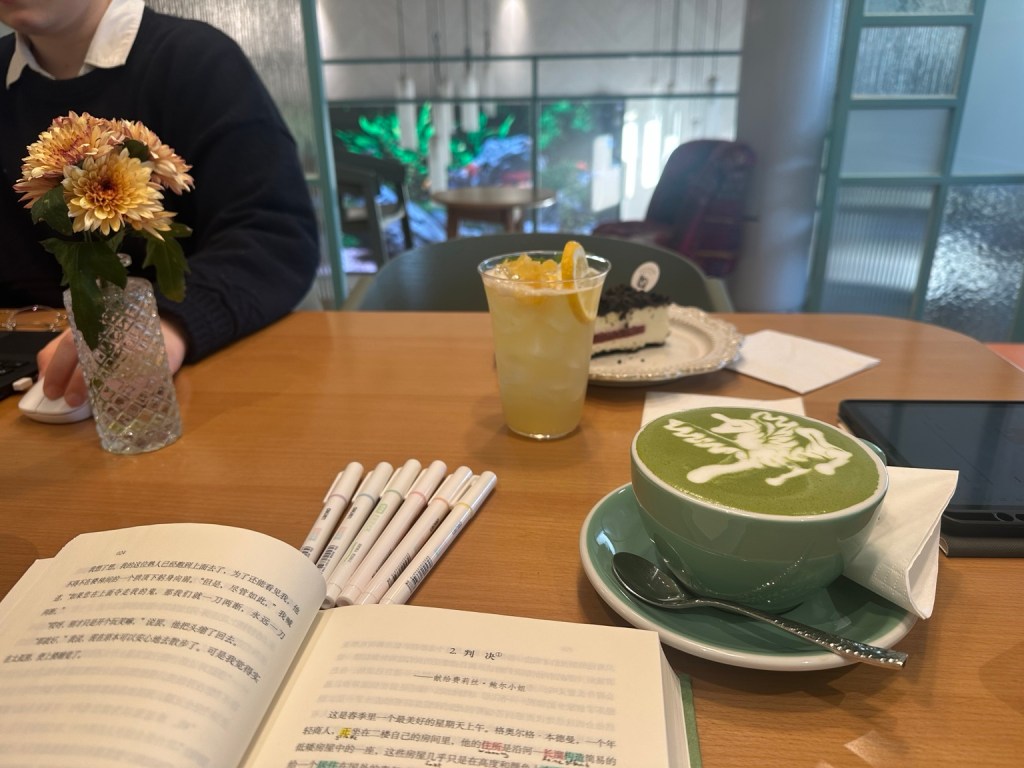
I would get up in the morning, take the bus to campus and go swimming before my first class started at 9:55. Lessons continued until three or sometimes four in the afternoon. Afterwards, instead of going home, I often found a café, treated myself to one of the beautifully presented matcha or coffee drinks I loved and continued studying for another four hours. Sometimes I did not leave until eight in the evening.
I studied in cafés at weekends too. Learning became an activity I genuinely looked forward to: a change of scenery, a small highlight in my day and often something I did together with friends.
Looking back, I appeared remarkably disciplined. I certainly studied more than I often manage to in Germany.
But I am still the same person.
So did I really work harder in China—or did my environment simply make it easier for my motivation to become visible?
The Part of Productivity We Can See
There is a familiar image of Chinese students as exceptionally hardworking and disciplined. It is not entirely wrong.
Many students in China study for very long hours. Their days can continue well into the evening, with classes, homework and preparation for demanding examinations. Academic expectations can be extremely high, and the workload is often considerable.
However, discipline is only one part of the picture.
What we see is the student sitting in the library late at night. What we do not necessarily see is the environment surrounding that effort: the campus, the residential system, affordable food, short distances, available study spaces and a community of people following similar routines.
During my year at a Chinese university, I fitted the image of the disciplined student myself. From the outside, it might have seemed as though I had suddenly developed extraordinary willpower.
What had actually changed was not my character, but the structure of my everyday life.
A Campus Built Around Student Life
At many of the larger Chinese universities I encountered, the campus was not simply a collection of lecture halls. It was an entire living environment.
Students commonly lived in dormitories on or near campus, and the infrastructure reflected that. Teaching buildings, libraries, canteens, cafés, sports facilities, shops and outdoor spaces were often concentrated in the same area. In theory, students could spend most of their time on campus without needing to leave it.
My own campus had almost everything I needed. I could study, eat, exercise and rest without travelling across the city between each activity. There was a large library, but learning was not confined to it. The corridors of teaching buildings also contained tables, comfortable seating and well-lit areas where students could sit between classes. Cafés welcomed people who opened their laptops and stayed to study.
Even taking a break was easy. Our campus had a lake where I could walk, breathe and let my mind rest for a moment before continuing with my day.
Exercise required very little additional organisation. The swimming pool was already on campus. I did not need to find a facility elsewhere, calculate a separate journey and then work out how to get from there to university. Once I had arrived, swimming, attending class, eating and studying could all form part of the same day in the same place.
That difference sounds small until every activity demands its own journey, decision and burst of motivation.
The Invisible Work Behind a Meal
The greatest difference may have been food.
In China, I could eat breakfast inexpensively in one of the campus canteens before class. I could return for lunch and either have dinner there or order something later. The food was affordable, varied and often freshly prepared. At some counters, I could watch the noodles being made by hand.
This meant that eating required very little planning.
I did not constantly need to remember which groceries I had at home, when they would expire or what I could cook with them. I did not need to interrupt an afternoon of studying because I still had to shop, travel home, prepare dinner and clean the kitchen afterwards.
In Germany, even when I am already sitting down to study, part of my mind is often managing the rest of the day:
I still need to do the laundry. I need to buy groceries. I need to cook.
Cooking is never only the half-hour spent in front of the stove. It begins with deciding what to eat, checking what is available and buying the ingredients. Afterwards, there is still a kitchen to clean. Altogether, it can easily remove an hour or more from the flow of a productive day.
None of these tasks is especially difficult on its own. Together, however, they create constant background noise. They occupy time, but also mental space.
When some of that work disappears, the energy it normally consumes becomes available for something else.
When Everyday Life Requires Less Management
Living in a dormitory also reduced other forms of invisible work.
I shared one room with three other students. Four people in one room did not offer much privacy, and the space still needed to be kept clean. At the same time, our individual household responsibilities were much smaller than those involved in managing an entire flat.
I did not have my own kitchen, living room or collection of household appliances to maintain. If something broke, I could inform the reception desk downstairs and someone would take care of it. I did not need to find a repair service, arrange an appointment, compare replacement appliances or work out who was responsible.
Payments and services were often handled quickly through my phone, while other practical matters were managed as part of the dormitory system.
These conveniences did not make studying effortless. Sharing a room could be exhausting in its own way. But the arrangement reduced the number of unrelated organisational tasks competing for my attention.
In Germany, students living independently may have to cook, clean, shop, organise repairs, manage bills and travel considerable distances alongside university. Some also work many hours because their families cannot or do not support them financially. Others live at home, have meals prepared for them and do not need to worry about rent.
From the outside, we may see only their academic results and decide that one person is disciplined while another is lazy. We rarely see how much unpaid and invisible work each person had to complete before they could even begin studying.
Learning as a Social Ritual
Infrastructure was not the only factor. Community mattered too.
Because I lived with other students, I was constantly surrounded by people who were also attending classes, completing assignments and preparing for exams. I did not always need to create motivation alone. Sometimes I could simply join a routine that was already happening.
One friend and I regularly went to a study café together. With another, I would sit in the café beneath the library while we waited before going home. We did not need to discuss whether we felt sufficiently motivated or devise an elaborate plan. Studying together gradually became a ritual.
That made learning feel less lonely. We could sit beside each other, order something enjoyable and focus on our own work. Going to a café also created a change of scenery and something pleasant to anticipate.
In many of the cafés I frequented in China, lingering over one drink while studying did not feel unusual. Large tables, comfortable seats and an atmosphere suited to longer stays made them natural learning spaces. In Germany, cafés are generally more expensive and are not always designed for students to occupy a table for several hours.
An inviting environment does not force anyone to study. It simply lowers the barrier between wanting to study and actually beginning.
China Was Still Exhausting
None of this means that university life in China was easy.
The workload could be intense. Students sometimes had classes until the evening and were expected to complete substantial amounts of homework outside those hours. Long days at university were normal, particularly for Chinese students facing significant academic pressure.
The environment could also be tiring because it was rarely completely quiet. Sharing one room with three other people, and living, eating, studying and socialising among so many students, meant that there was almost always some background noise or activity.
The academic calendar created another form of exhaustion. China has long summer and winter holidays, but relatively few well-distributed breaks during the semester. In my winter semester, for example, we had a week off relatively soon after classes had begun—when I did not yet feel that I needed it. Afterwards, the semester continued until January without another substantial pause.
I was productive in China, but I was also exhausted at times.
The infrastructure supported learning, yet the system simultaneously demanded a great deal of it.
More Than One Campus
My observations are based primarily on my own life at a university in Beijing. They are not a scientific comparison of every Chinese and German university, and they should not be read as one.
Part of the difference also came from my living situation. In China, I shared a dormitory room with other students, and studying was the clear centre of my life. In Germany, living more independently naturally creates additional responsibilities.
Still, I do not think my experience was unique to one campus.
While travelling, I visited other Chinese university campuses and repeatedly encountered similar dimensions and structures, particularly at larger and more prestigious institutions. I also saw study cafés and learning-oriented spaces in different cities.
China and Germany organise student life differently. In China, living in a dormitory on or near campus is much closer to the norm. In Germany, shared flats and more dispersed living arrangements are common, while university facilities are not necessarily designed to cover most aspects of daily life.
The residential model and the infrastructure cannot really be separated. Dormitories are commonly located on or near campus because the campus is designed as a place where students live, not only somewhere they attend lectures.
Discipline Does Not Exist in a Vacuum
Chinese students really do work extraordinarily hard. Acknowledging the conditions surrounding their work does not diminish their achievement.
But describing that achievement as a matter of character or culture alone leaves out an important part of the story.
Discipline is easier to observe when an environment allows a person’s energy to flow visibly into one goal. When food, exercise, study spaces, accommodation and friends are all nearby, studying can become the natural continuation of the day. When those elements are scattered, the same person may spend much more energy simply keeping everyday life running.
I did not become a fundamentally different person when I moved to China. Nor did my character suddenly change when I returned to Germany.
What changed was how much friction stood between my intention to study and the moment I actually opened my books.
This experience has made me more cautious about describing people as hardworking, disciplined or lazy. We see their output, but not the conditions that produced it. We do not see who has to work alongside university, who receives financial support, who has meals waiting at home, who manages an entire household and who spends hours travelling between different parts of their life.
We see the results. We rarely see the infrastructure behind them.
Universities cannot remove every burden from students’ lives. But if they want students to learn well, they should create conditions that make learning realistically possible: inviting study spaces, places to rest, affordable and nutritious food, accessible facilities and infrastructure built around how students actually live.
Perhaps hard work is partly a matter of discipline.
But before judging how much discipline someone possesses, we should ask how much of their energy survives the work of everyday life.
 Anna Between Worlds
Leave a comment