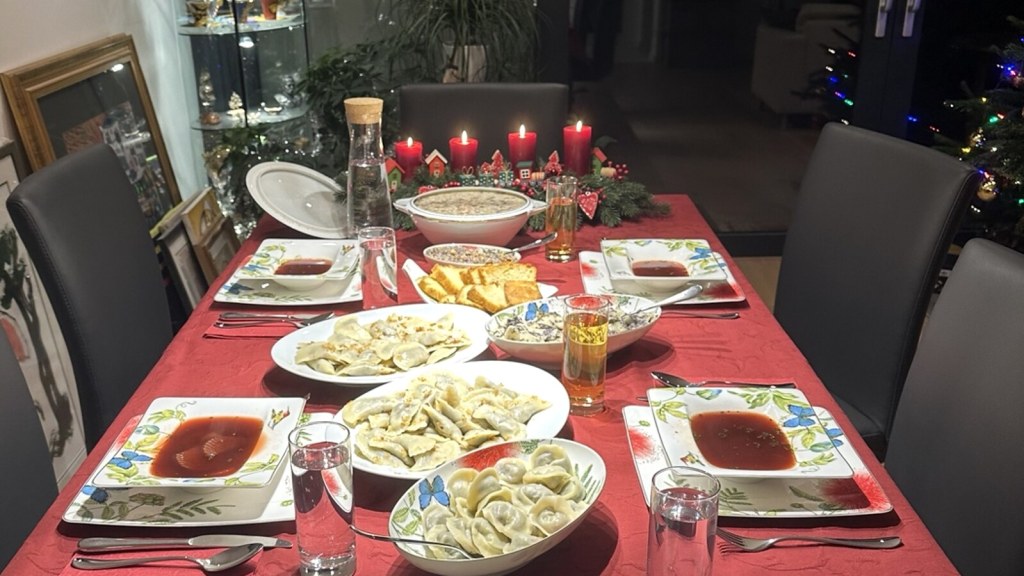
Some of my clearest memories of Polish Christmas begin at the kitchen table.
There would be dough to roll out, circles to cut and pierogi to fill and fold together. Around us, preparations continued for a Christmas Eve dinner without meat: barszcz, carp, pierogi and more poppy-seed desserts than we could possibly finish in one evening. Before eating, we shared opłatek, wishing one another well and saying what we appreciated about each other. Only after dinner did we open our presents.
For a long time, none of this felt particularly unusual to me. It was simply Christmas.
I was born and raised in Munich, but the first language I learned was Polish. At home, I spoke it with my parents and my sister, while German surrounded me outside and gradually became just as natural through kindergarten, school and everyday life.
Today, the languages in my family depend on the person and the moment. I speak Polish with my grandmother and my parents—although German words regularly find their way into our conversations when they fit better or when no Polish translation feels quite right. With my sister, I now mainly speak German. With my step-grandfather in Ireland, I speak English.
Our family conversations have never belonged to only one language.
Polish at Home, German Outside
The Polish side of my childhood was most visible during celebrations. Besides Christmas, we observed traditions many of my German friends did not know, such as Children’s Day and taking a decorated Easter basket to church to be blessed.
There were Polish children’s programmes that other children around me had never seen and a home environment that was perhaps slightly more conservative and strongly focused on education. My parents cared deeply about giving my sister and me as many opportunities as possible. My mother studied with me during primary school and made sure I could learn the piano, take part in sports and develop interests that might open doors for me later.
Still, I cannot remember one dramatic moment when I suddenly realised that my family was “different”. Families were different from one another anyway, and ours was simply one of them.
I also never felt that being German and Polish required me to choose between two opposing sides. Both were part of my normal life.
In Germany, most people do not realise that I have Polish roots unless I mention them. My surname is usually the only clue—and it is almost always pronounced differently. I have grown used to accepting every version of it. As long as I know someone means me, I do not really mind.
Visiting an Old Friend

Poland itself occupies a slightly different place in my sense of belonging.
I visited more frequently when I was younger and roughly once a year later on. Sometimes we went on holiday or visited relatives, although some trips felt less like holidays because my father often had practical things to take care of while we were there.
Today, arriving in Poland feels a little like visiting a very good old friend. It is familiar in ways that go far beyond tourism. I speak Polish well, even if people can sometimes hear that I did not grow up there, and I recognise the food, customs and small details of everyday life.
I think of the simple places where you can stop for an uncomplicated, comforting lunch. I think of schnitzel, Polish soups, cured meats and little baked cheese treats. I think of old kamienice—the historic apartment buildings with their cool stairwells and that distinctive, slightly musty scent I have always strangely loved. It might sound mundane, but that scent is part of Poland for me.
Poland feels close, familiar and meaningful. Yet it does not feel entirely like “home home”. I did not grow up with the same close community there that I later found elsewhere, and some of the family members I feel closest to have built their lives outside Poland.
A Family Across Borders
My family lives not only in Germany and Poland, but also in the United Kingdom and Ireland. Because our relatives were rarely just around the corner, seeing one another was never something we could take for granted. Visits were less frequent, but often lasted a week and felt particularly intense and precious.
My aunt used to live in Edinburgh and later moved to London. Even my early relationship with English was connected to family. My mother collected English-language Disney VHS tapes for us, turning films into our own informal English lessons long before the language became an important part of my life.
Over time, Cork became especially meaningful to me.
My grandmother moved to Ireland and met my step-grandfather there. I usually visit them about once a year, whenever life and longer periods abroad allow it. Arriving at their home feels warm and effortless. Cork has become a place where I can relax and, for a while, stop worrying.
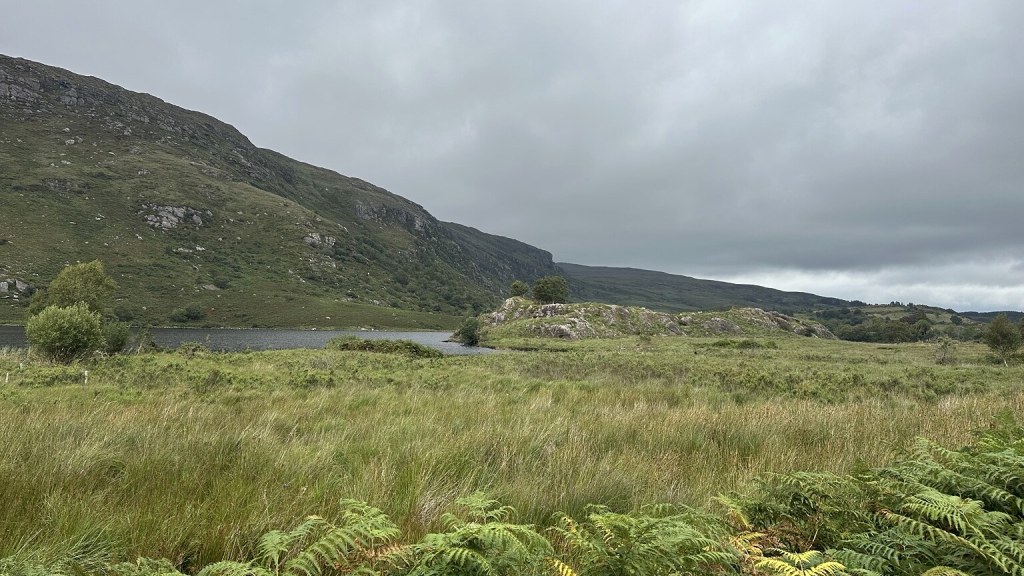
My grandmother’s house has a small garden into which she pours an enormous amount of care. She cooks for us, and we spend a lot of time talking. Sometimes we drive farther away for a walk through the green Irish landscape, catching glimpses of the sea. On other days, we drive to the beach—not necessarily to swim in the cold water, but to walk, collect shells and be near the ocean. More recently, my grandmother has also had an extremely sweet dog waiting there.
Ireland is beautiful, but it is not only the landscape that makes Cork feel like another home. It is the life and the people waiting for me there.
Home as a Network
Growing up with a family spread across different countries taught me early that home did not have to be a single point on a map.
Home could be Munich, where I was born and grew up. It could be the Polish spoken around our kitchen table. It could be the smell of an old kamienica or the familiar food at a simple Polish lunch counter. It could be my grandmother’s garden in Cork, an English conversation with my step-grandfather or a walk near the Irish coast.
The people mattered more than the borders.
Living abroad was therefore never a completely foreign idea in my family. I knew that people could leave one country, build a life somewhere else and create a new kind of home without erasing the places that had come before it.
Perhaps that is one reason why, as a teenager, going abroad for an entire year did not feel impossible to me.
At first, I considered more typical exchange destinations such as the United States. But I wanted to experience something that felt genuinely unfamiliar. A family trip to Thailand had strengthened my curiosity about Asia, while Chinese characters, food and the challenge of learning the language increasingly drew me towards China.
Living with a Chinese host family offered something especially valuable: the chance to experience everyday life from the inside—to learn not only what a place looked like, but how people lived, thought, ate and related to one another.
That decision eventually added another place to my personal map of belonging.
China became part of my life through language, music, food, my host family and friendships that grew deeply important to me. But that is a much longer story—and one for another post.
A Home That Keeps Growing
I do not think of myself as someone trapped between cultures, unable to belong fully to any of them. I feel German and Polish, while Ireland and China have become parts of my idea of home in different ways.
Not every connection has the same origin or the same meaning. Poland is part of my family history and childhood. Cork is connected to my grandmother, comfort and a sense of being able to breathe. China became a home I actively built through time, language, relationships and shared experiences.
Together, these places shaped the way I approach cultures today. A country is never interesting to me only as a destination, a flag or a list of facts. What makes it meaningful are the people I meet there, the meals we share, the languages in which we try to understand one another and the memories that remain after I leave.
Perhaps that is why Anna Between Worlds feels like the right name for this space.
For me, being between worlds does not mean belonging nowhere.
It means discovering that home can grow.
 Anna Between Worlds
Leave a comment